
In today’s digital landscape, where innovation is advancing at a rapid pace, cybersecurity has become a critical priority for businesses of all sizes. With cyberattacks becoming more sophisticated and frequent, the need for effective solutions has never been more urgent. This is where Artificial Intelligence (AI) comes into play as a powerful ally.
Summary
AI in Cybersecurity: Predictive Analytics and Continuous Learning
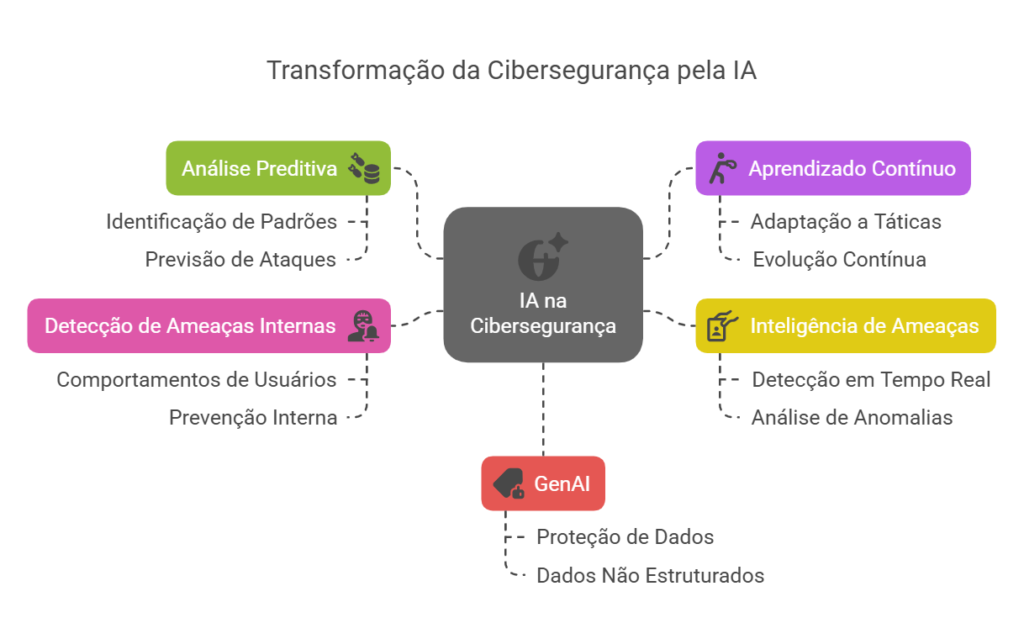
AI enables cybersecurity systems to analyze large volumes of data to identify patterns and trends that may indicate future attacks. This is done by predictive analysis, which uses machine learning algorithms to predict and prevent attacks before they even occur. In addition, AI continually adapts to new cybercriminal tactics, making security systems increasingly effective over time. For a practical example of how AI is revolutionizing efficiency in complex processes and significantly reducing analysis time, check out our article Due Diligence 4.0: How AI Reduced Analysis Time by 70% in Banks and Law Firms.
In today’s digital landscape, where innovation is advancing at a rapid pace, cybersecurity has become a critical priority for businesses of all sizes. With cyberattacks becoming more sophisticated and frequent, the need for effective solutions has never been more urgent. This is where Artificial Intelligence (AI) comes in as a powerful ally, transforming the way we face cyber threats by enabling accurate predictions and effective preventions before attacks even occur. For a more detailed look at how AI can mitigate cyber risks and protect privacy, check out our companion article AI and Data Protection: How to Mitigate Cyber Risks and Privacy in the Future of Technology.
AI in Threat Intelligence: Proactive Detection
AI is also being used in threat intelligence to proactively detect cyberattacks. By analyzing vast data sets, AI-powered systems can identify anomalies and patterns that signal potential threats, allowing security teams to intervene before attacks cause significant damage. Additionally, AI helps detect insider threats by analyzing user behaviors and identifying deviations from normal patterns. To explore how AI is transforming financial fraud detection and reducing losses for businesses, see our white paper How AI Reduces Financial Fraud Losses in Businesses by 50%.
The application of machine learning algorithms in cybersecurity has revolutionized the way we identify and prevent threats.
Deep Neural Networks are used to detect complex patterns in large volumes of data, making them ideal for identifying anomalies that may indicate malicious activity. Support Vector Machines (SVM) are used to classify and detect intrusions, helping to distinguish between normal and potentially dangerous traffic. In addition, Random Forests combine multiple decision trees to improve accuracy in fraud detection and log analysis. With the use of K-Means Clustering, it is possible to segment data and identify clusters of suspicious behavior. These techniques, combined with the adaptive capacity of AI, allow for a proactive and effective defense against cyberattacks.
Cybersecurity Trends for 2025
In 2025, the cybersecurity landscape is marked by significant innovations, as highlighted by Gartner. One of the main developments is the use of Generative Artificial Intelligence (GenAI) to protect unstructured data such as text, images and videos. This approach reflects the shift in security focus, now broadened to include protecting data in a variety of formats.
Additionally, organizations are increasingly focused on managing machine identities due to the increased use of cloud services and automated processes. This management is crucial to mitigating risks associated with these emerging technologies.
Optimizing security tools has become essential, with companies collaborating internally to create more effective and comprehensive security programs. Integrating AI into security culture programs continues to reduce employee-related incidents, promoting safer work environments.
These trends demonstrate continued advancement in how organizations address digital challenges, ensuring resilience and protection amid an increasingly complex threat landscape.
Success Stories: Companies Using AI in Cybersecurity
IBM: Watson for Cybersecurity
The IBM has used Watson to improve its cybersecurity operations. Watson analyzes large volumes of unstructured data, such as blogs and research papers, to identify and correlate threats more quickly and accurately than traditional methods.
Microsoft: Microsoft Intelligent Security Graph
The Microsoft integrated AI and machine learning algorithms into its Microsoft Intelligent Security Graph, which processes over 6.5 trillion signals daily. This system uses advanced analytics to detect anomalies, identify threats, and provide insights to security teams. With automation and integration, IT and security teams were able to accomplish more with fewer resources, avoiding a 50% increase in team size. This resulted in a additional savings of $2.6 million over three years
Boardriders: AI-Powered Fraud Detection
Boardriders has implemented Darktrace’s AI technology to protect its global operations. The AI has learned the normal behavior patterns of users and devices, allowing it to detect subtle deviations that indicate potential threats.
Infographic: How AI is Transforming Cybersecurity
Relevant Data
- Cost of Cybercrime in 2023: Over $1.4 trillion, according to Cybersecurity Ventures.
- Use of AI in Cybersecurity: Expected to increase by 2025, with a focus on advanced automation.
- Cutting-edge technologies: GenAI and machine learning are fundamental to modern cybersecurity.
AI Tools for Cybersecurity
Darktrace Enterprise Immune System
Operation: Darktrace uses Self-Learning AI to model the normal behavior of users and devices within a network. It identifies anomalies in real time, enabling detection of unknown threats and autonomous response to ongoing attacks.
Benefits:
- Proactive Detection: Identifies threats before they cause significant damage.
- Autonomous Response: Neutralizes attacks in real time, minimizing human intervention.
- Holistic Coverage: Protects against a wide range of vulnerabilities across cloud, email, endpoint, and operational technology environments.
Microsoft Security Copilot
Operation: Microsoft Security Copilot uses a specialized language model integrated into the Microsoft security ecosystem. It processes more than 65 trillion signals daily, providing real-time threat analysis and automated response. The tool also uses Natural Language Processing (NLP) to simplify interaction with the platform.
Benefits:
- Advanced Detection: Identifies complex threats that may go undetected by traditional tools.
- Quick Response: Automates repetitive tasks, freeing security teams to prioritize critical threats.
- Integration with Microsoft Defender: Provides a unified and adaptive defense.
SentinelOne Purple AI
Operation: The SentinelOne Purple AI platform combines machine learning and automation to efficiently detect and respond to threats. It analyzes behavioral patterns in real time, identifying anomalies that may indicate attacks.
Benefits:
- Real-Time Detection: Identifies and responds to threats quickly, minimizing attack time.
- Behavioral Analysis: Provides deep insights into suspicious activity, helping prevent future attacks.
- Simple Interaction: It uses NLP to facilitate the interaction of security professionals with the platform.
These AI tools significantly improve companies’ ability to detect and respond to cyber threats, offering proactive and efficient protection against increasingly sophisticated attacks.
As technology advances, cybersecurity continues to be a dynamic and essential field. Artificial Intelligence is not only transforming the way we protect our data, but it is also redefining security strategies across the globe. Staying up to date with current trends is crucial to ensuring resilience against emerging threats.
We invite you to follow our blog to stay informed about the latest news in cybersecurity and technological innovation. If you want to know more about how AI Connect can help your company strengthen its digital defenses, don't hesitate to get in touch with our sales team. We are here to help you navigate this challenging landscape with confidence and effectiveness.